
Zoe Hancox

AI Engineer in Health and Veterinary AI

Hi, I'm Zoe

I build practical machine learning tools that are safe, reliable, and useful in real-world healthcare settings. I currently work at Vet-AI, and my research background is in graph-based modelling for electronic health records.

Outside of work you will usually find me doing yoga, cuddling my cat, jogging, gardening, reading dystopian or fantasy novels, or making wacky greeting cards.

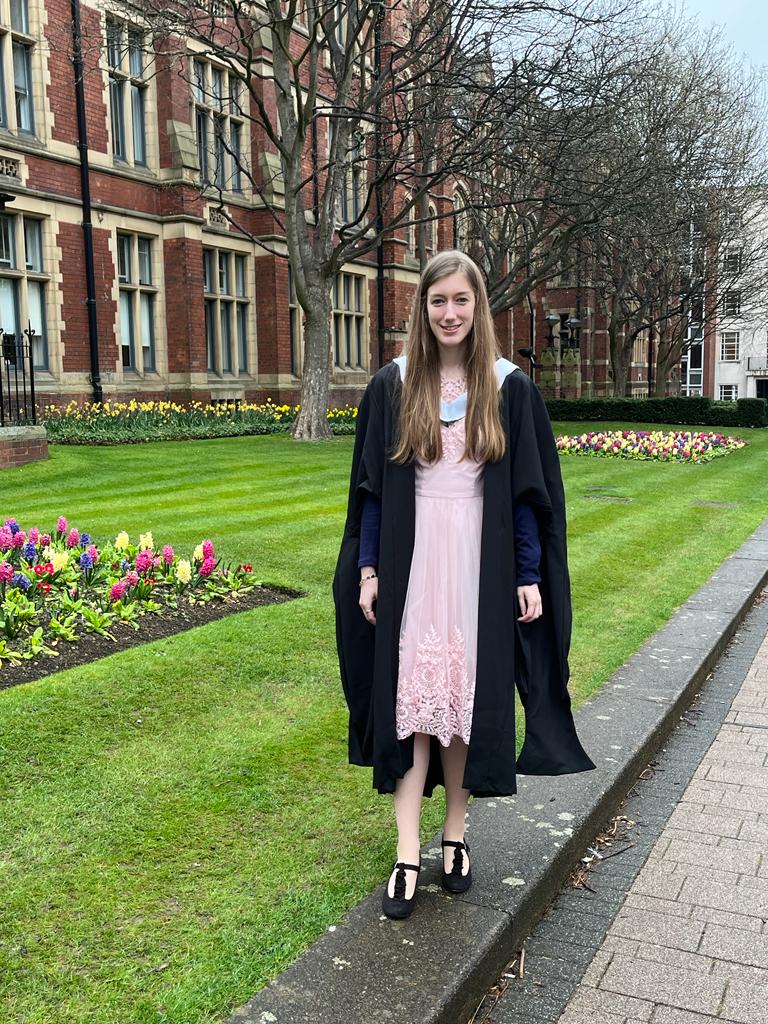
Portrait of Zoe Hancox Zoe doing beach yoga

My PhD Thesis

PhD Title: Temporal Graph-based Convolutional Neural Networks for Electronic Healthcare Record Prediction.

This PhD was funded through the UKRI Centre for Doctoral Training in Artificial Intelligence for Medical Diagnosis and Care.

My PhD research revolved around using graphs (also called networks, the kind where nodes are linked via edges) to analyse data or make predictions of health outcomes. In particular creating temporal graphs and applying 3D convolutional neural networks to make predictions of health outcomes such as hip replacement using patient historical electronic healthcare records.

TL;DR Summary

This thesis introduces a Temporal Graph-Based Convolutional Neural Network (TG-CNN) that models Electronic Health Records as temporal graphs to predict hip and knee replacement risk up to five years in advance, achieving AUROC scores as high as 0.967. While the model delivers strong predictive performance, further work on explainability is needed to support its translation into real-world clinical decision-making.
Experience

AI Engineer @ Vet-AI

I currently work as an AI Engineer at Vet-AI, where I spend most of my time thinking about how machine learning can actually be useful in a real-world healthcare setting in ways that genuinely help people and their pets.

A big part of my role is working on an LLM-powered triage tool that helps pet owners understand what might be going on before they speak to a vet. It is the kind of problem that sounds straightforward at first, but quickly becomes complex. You need to balance helpfulness with safety, make sure the right questions are asked at the right time, and ensure the system behaves reliably across a wide range of scenarios.

Day-to-day, my work sits somewhere between data science and product. I dig into large datasets in Google Cloud to understand how the system is performing, where it is falling short, and what can be improved. From there, it is an iterative loop of refining the model, testing changes, and pushing improvements into production.

Postdoctoral Researcher @ The University of Leeds

PREDICT (Pragmatic Recalibration and Evaluation of Drift In Clinical Tools)

  • Developed algorithms to detect and correct temporal drift in clinical prediction models.
  • Applied models to QRISK and eFalls using clinical data from Connected Bradford.
  • Engaged with patients and stakeholders.

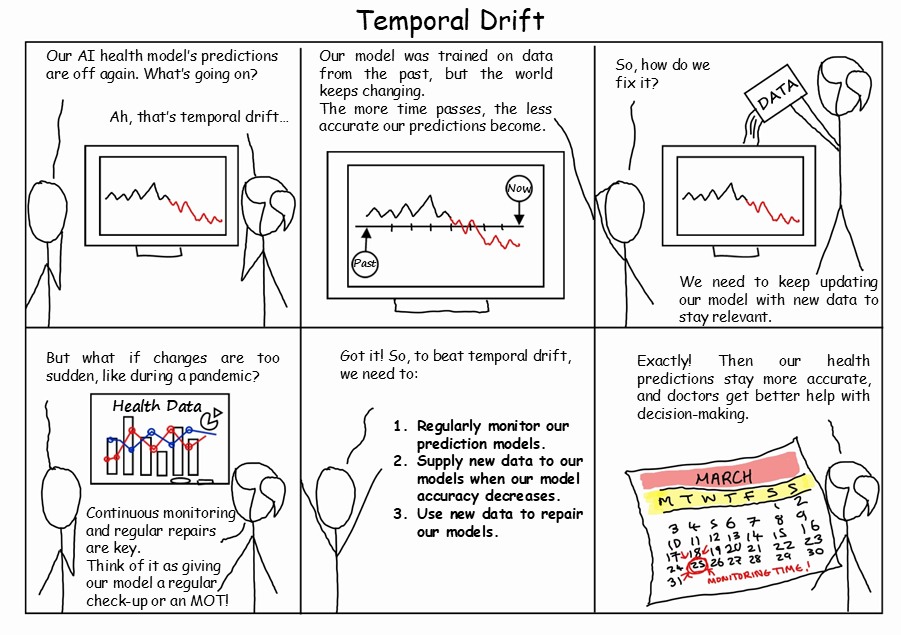
What is temporal drift?

What is temporal drift

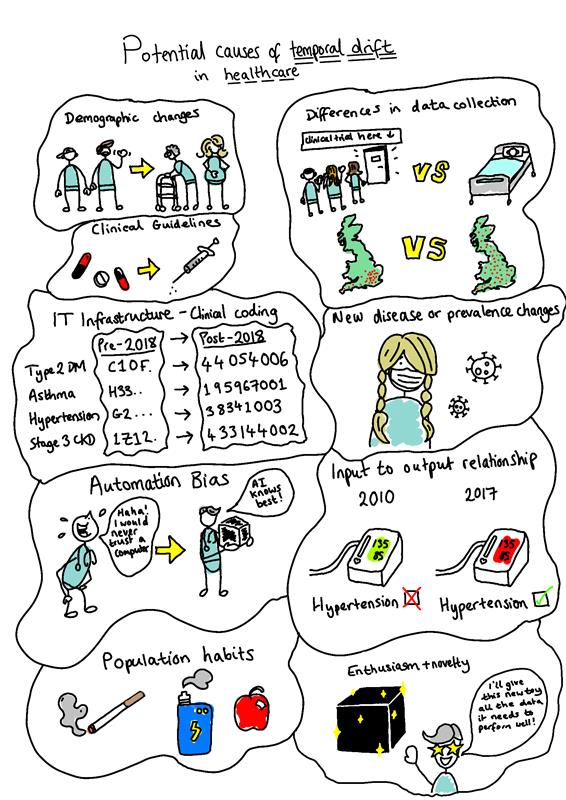
What causes temporal drift?

What causes temporal drift

Teaching: Co-lead on the Artificial Intelligence and Machine Learning in Health module at the University of Leeds. I also supervise MSc students in their final health informatics and data science projects.

LIDA Health Early Career Researchers Committee Co-lead: Host and organise workshops on research enhancement and technical skills, health research talks, and career development sessions for ECRs.

Data Scientist @ NHS England: We transformed healthcare data using graph-based techniques using SAIL DataBank data. Hypergraphs were applied to study multimorbidity pathways, helping to reveal complex relationships between conditions. The results were shared NHS-wide and made publicly available through an open repository and report. Learn more about how hypergraphs work and how to use them in this context via our interactive Streamlit app.

Applications and Implications of Artificial Intelligence (AI^2) President: I was one of the conceptualisers and founders of the Applications and Implications of Artificial Intelligence (AI^2) Forum at the University of Leeds.

What is the AI^2 forum? The Applications and Implications of Artificial Intelligence (AI^2) forum aims to bring students and researchers together to talk about different areas of AI and data science. It is used to encourage like-minded researchers to network and give people the opportunity to deepen their knowledge and share ideas. This forum is held on the last Wednesday of every month from 4 to 6pm. Sessions are also held with representatives from industry, where these representatives speak about their career pathway, the company they work at and any work they are undertaking that uses AI.

If you want to find out more you can read our blog summarising some of our sessions.

Journal Club Co-Chair: I co-chaired and helped arrange weekly journal clubs for the CDT.

Need some inspiration?